

Education and training beyond initial registration
We recognise that in today’s health and care services, the roles of nurses, midwives and nursing associates (in England) are changing and expanding,requiring higher levels of autonomy, knowledge and skill in order to achieve their full potential and to contribute to the delivery of services for the benefit of the people they serve. Everyone on our register undertakes additional education and training after their initial professional registration to develop further knowledge and skills, but not all of this ongoing education is or needs
to be regulated.
We take a proportionate approach to the regulation of post-registration qualifications. We reserve regulation for those areas where ensuring consistency of standards of proficiency, and standards for education and
training, is needed to achieve a higher level of quality and safety in order to mitigate risk and to reassure the public. One of the means we have of recognising post-registration qualifications is through setting standards of proficiency for specialist community public health nurses (SCPHN).
The role of the specialist community public health nurse in the 21st century
SCPHN professionals are in the frontline of public health. They are culturally competent, autonomous practitioners who are committed to improving people’s health and wellbeing. They understand the wider determinants of health and seek to address health inequalities across the diverse
communities and populations they serve.
All SCPHNs work in partnership with people to prevent ill health, protect health and promote wellbeing. Using a formidable evidence base they will lead, influence and collaborate with other agencies, organisations and professionals to improve and embed sustainable changes to the overall health and wellbeing of people at home, within communities, in schoolsand in the workplace. SCPHNs play a key role in the safeguarding of those people who are most vulnerable in society, and are ambitious for the public
health of the communities they serve. They actively pursue sustainable development goals that promote everyone’s right to a healthy life.
SCPHN health visitors (HV) are uniquely placed to reach every child in their own home, and be connected to their whole family and community. They build trusting relationships with children, carers and families, to
positively influence their future health outcomes. They identify their health needs and strengths and deliver timely, effective, evidence-based interventions in partnership with them. They provide a universal service
that ensures support for children and families is personalised, effective, timely and proportionate. The needs and the welfare of the child are at all times central to their work.
Health visitors use their professional autonomy to adapt and tailor their response to the health and wellbeing needs of individuals, families andcommunities within diverse and changing contexts. They are sensitive to different cultural perspectives and use in-depth knowledge of local communities to develop strong community relationships and to connect families with the community resources that best meet their needs.
Health visitors are advocates for fairness, equity and social justice and will challenge discriminatory practices and behaviours. They understand the impact of the wider determinants of health and are committed to addressing health inequalities through prevention and early intervention,
and the promotion and improvement of health.
They lead services that are evidence driven, with creativity and resourcefulness, and evaluate the impact of their interventions to continuously improve the quality of care and outcomes for children and families. They maximise the positive impact of health visiting services by working within a collaborative system, planning and coordinating care and maintaining continuity across different services and agencies. They embrace and champion new technologies and are skilled in leading changes in service delivery.
SCPHN health visitors (HV) are uniquely placed to reach every child in their own home, and be connected to their whole family and community. They build trusting relationships with children, carers and families, to positively influence their future health outcomes. They identify their health needs and strengths and deliver timely, effective, evidence-based interventions in partnership with them. They provide a universal service that ensures support for children and families is personalised, effective, timely and proportionate. The needs and the welfare of the child are at all times central to their work.
Health visitors use their professional autonomy to adapt and tailor their response to the health and wellbeing needs of individuals, families and communities within diverse and changing contexts. They are sensitive to different cultural perspectives and use in-depth knowledge of local communities to develop strong community relationships and to connect families with the community resources that best meet their needs.
Health visitors are advocates for fairness, equity and social justice and will challenge discriminatory practices and behaviours. They understand the impact of the wider determinants of health and are committed to addressing health inequalities through prevention and early intervention, and the promotion and improvement of health.
They lead services that are evidence driven, with creativity and resourcefulness, and evaluate the impact of their interventions to continuously improve the quality of care and outcomes for children and families. They maximise the positive impact of health visiting services by working within a collaborative system, planning and coordinating care and maintaining continuity across different services and agencies. They embrace and champion new technologies and are skilled in leading changes in service delivery.
SCPHN school nurses (SN) are autonomous practitioners who uphold the rights of school-aged children and young people at all times. Working collaboratively across health, education and other agencies, and as an integral part of a broader public health service, school nurses advocate for optimum health for all school-aged children and young people, seeking to ensure that services are fair, inclusive, equitable, anti-discriminatory and positively influence health and wellbeing.
Using a variety of advanced communication skills, school nurses build mutually trusting relationships with school-aged children and young people,and parents, carers and families. Importantly, school nurses actively listen to school-aged children and young people, taking account of what matters to them and always putting the needs, welfare and safety of school-aged children and young people first.
School nurses provide culturally appropriate support and early interventions which aim to promote positive choices and reduce risk-taking behaviours. They focus on and support the holistic needs of school-aged children and young people. They understand the wider determinants of health and are committed to addressing health inequalities across the life course, through health education, health promotion and evidence-based age and maturity appropriate interventions.
They know their community and its assets and lead services that are person-centred and evidence driven to ensure positive health outcomes for school-aged children and young people. They collaborate and work
effectively with teams and other professionals across a range of sectors and agencies.
SCPHN occupational health nurses (OHN) lead and work in a range of work environments and sectors. They lead services to enhance the health and wellbeing of people in their workplaces and beyond. Working autonomously, they promote and protect the health of the workforce, ensuring a healthy balance between work and wellbeing. As a distinct group of public health professionals, they help to prevent work-related ill health and disease by advising on the creation of workplaces that are safe, efficient and inclusive.
Occupational health nurses collaborate with other professionals, sector experts, employers and employees to lead workplace health initiatives that are responsive to the needs of individuals and organisations. They are able to use and analyse data effectively, combining their specialist nursing skills with
broader understanding and experience of the distinct sector they work in to embed health initiatives in the wider organisational planning for the benefit of people and communities and in addressing inequalities.
Applying their professional judgement and business acumen, occupational health nurses create innovative strategies for inclusive workplaces that enable people of varied abilities to be productively employed.
They champion the need for workplace health and wellbeing strategies that recognise the impact of health on work and the value of work to health. Recognising the value of a diverse working population, occupational health nurses embed person-centred approaches to health that address the needs
of a varied workforce.
They are change agents who influence at strategic and sector level, thinking globally but acting locally, to create a healthy workforce for the present and the future.
SCPHN public health nurses (PHN) are specialists in public health who do not have a predetermined field of SCPHN practice. They may work in roles across a wide range of sectors and settings, applying their specialist public health knowledge and skills to the people, communities and populations they serve.
They take a life course and whole population approach to make a valuable contribution to the wider society’s health and wellbeing and in addressing health inequalities. They advocate for people, fostering therapeutic relationships that build confidence and trust. They may provide public health information, support and timely interventions to people. Equally they may offer public health advice and support to voluntary or third sector organisations within the wider community.
They proactively collaborate with interdisciplinary and interagency teams and services, seeking to ensure that people who require wider public health support, care and interventions have fair and equitable access to public health resources that promote their health and wellbeing, prevent ill health and protect those who are vulnerable.
How to read these standards
The proficiencies in this document specify the knowledge, skills and behaviours that registered nurses and midwives go on to achieve to support and care for people, communities and populations across the life course in specialist community public health nursing roles.
They reflect what the public can expect SCPHN health visitors, school nurses, occupational health nurses and SCPHN public health nurses to know and be able to do in order to lead, collaborate, promote, protect and prevent ill health across the life course.
Core standards of proficiency that apply to all fields of SCPHN practice: HV, SN, OHN and PHN, and are grouped under six spheres of influence, and;
These core standards of proficiency apply to: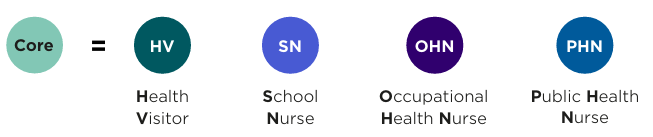
Field specific standards of proficiency that apply to each of the following fields of SCPHN practice: HV, SN and OHN, and are grouped under four of the six spheres of influence.
These field-specific standards of proficiency apply to: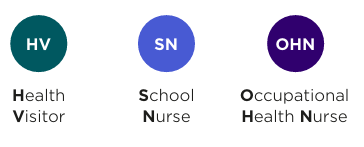
These proficiencies will provide new post-graduate specialist community public health nurses entering the profession with the knowledge, skills and behaviours they need at the point of registration. SCPHN health visitors, school nurses, occupational health nurses and SCPHN PHNs will build on these proficiencies as they gain experience and fulfil their professional responsibility. They will demonstrate their commitment to develop as a SCPHN practitioner and to build a career pathway, engaging in ongoing education and professional development opportunities necessary for revalidation.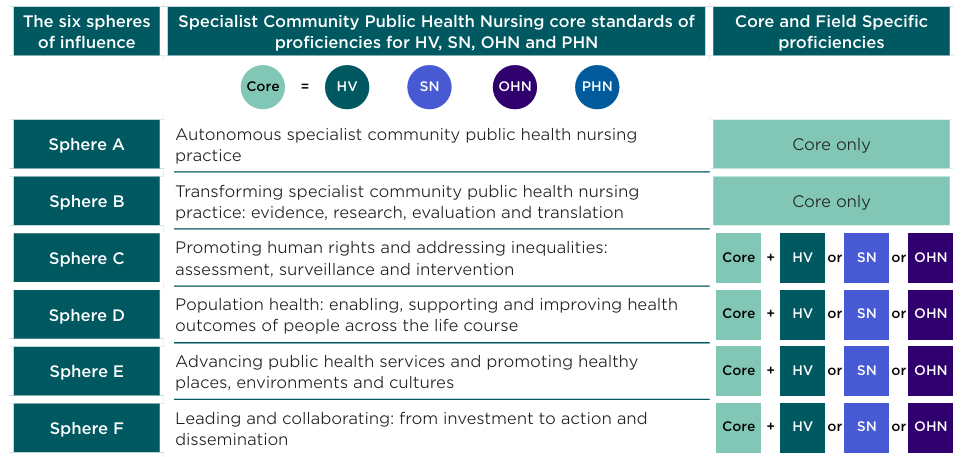
The nature of regulatory standards
Regulatory standards are intended to be high level and outcome-focused. They are translated by education institutions and their practice placement partners into more detailed curricula and programme learning outcomes.
These core and field specific standards of proficiency apply to all NMC registered SCPHN HVs, SNs and OHNs. The core standards of proficiency also apply to all NMC registered SCPHN PHNs. They should be read alongside the standards for education and training, which set out our expectations regarding provision of all pre-registration and post-registration NMC approved nursing and midwifery education programmes.
These standards apply to all approved education providers and are set out in three parts:
Part one: Standards framework for nursing and midwifery education
Part two: Standards for student supervision and assessment
Part three: programme standards, which are the standards specific for each pre-registration or post-registration programme.
Education institutions must comply with our standards to be approved to run any NMC approved programmes. Together these standards aim to provide Approved Education Institutions (AEIs) and their practice learning partners with the flexibility to develop innovative approaches to education for SCPHN health visitors, school nurses, occupational health nurses and SCPHN public health nurses while being accountable for the local provision and management of approved post-registration SCPHN programmes in line with our standards. The relationship between the different sets of standards is shown in the diagram on the next page.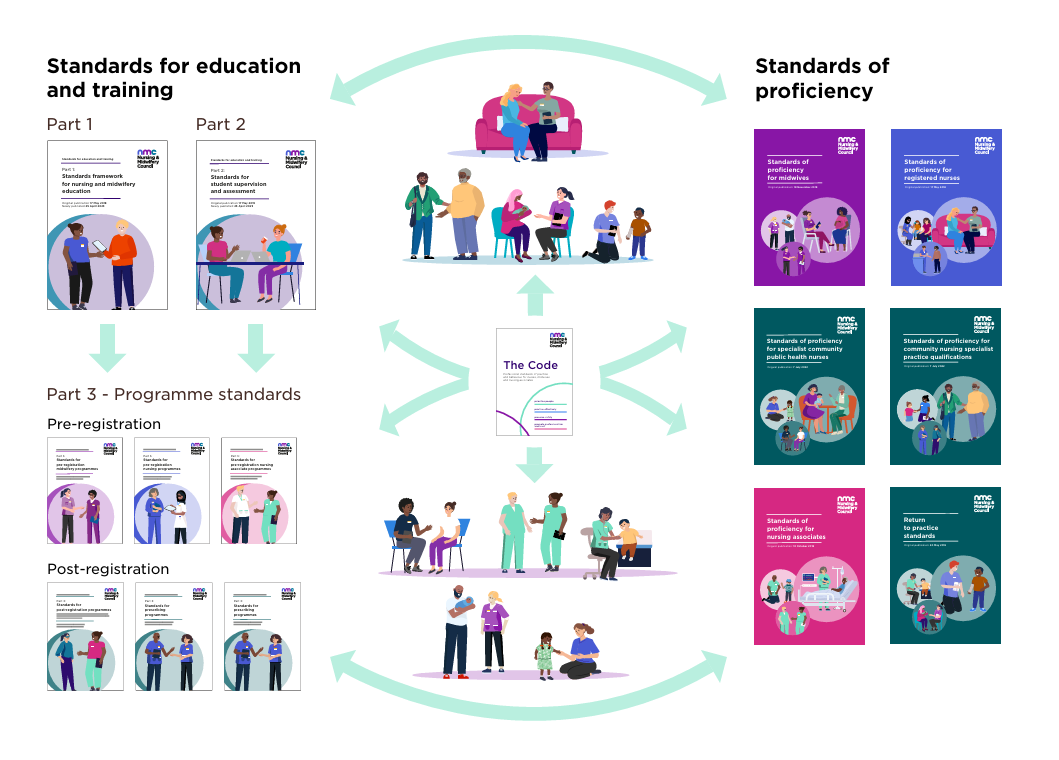
Legislative framework
Article 15(1) of the Nursing and Midwifery Order 2001 (‘the Order’) requires the Council to establish standards for education and training which are necessary to achieve the Nursing and Midwifery standards of proficiency for admission to the register, as required by Article 5(2) of the Order. The standards for nursing and midwifery education providers are established under the provision of Article 15(1) of the Order.
Article 5(2) of the Order requires the NMC to establish standards of proficiency necessary to be admitted to each part of the register and for safe and effective practice under that part of the register. The standards of proficiency have been established under this provision.
As SCPHN standards of proficiency are post-registration standards, individuals can only enter the SCPHN part of the register if they are a registered level one nurse or midwife and have successfully met all the requirements of their NMC approved SCPHN programme. Only those on our register can use the protected title of specialist community public health nurse.


