

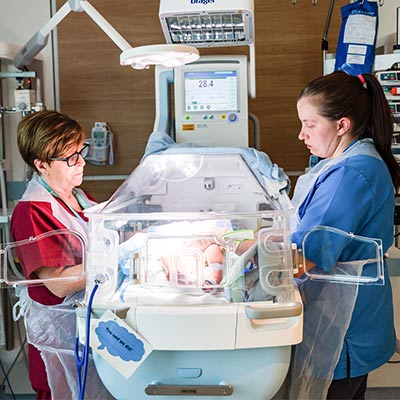
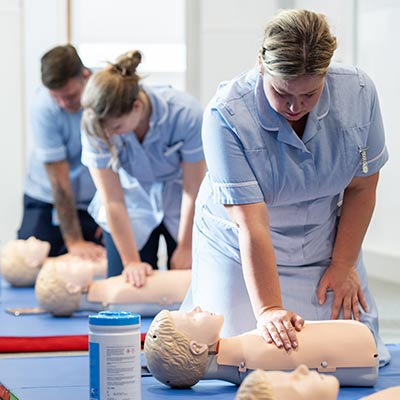
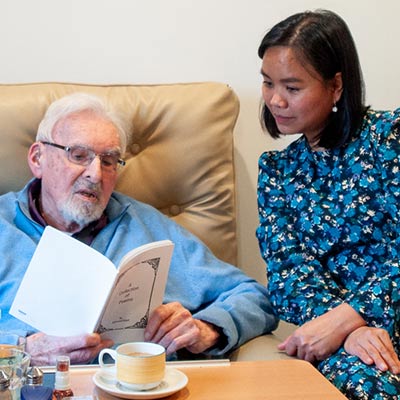


The proficiencies serve a number of purposes:
- They set out for patients and the public what nursing associates know and can do when they join the NMC register.
- The standards help nursing associates by providing clarity about their role. Read alongside the nursing standards of proficiency, they demonstrate the synergies and differences between the two roles.
- For nurses and other health and care professionals, the standards provide clarity on the knowledge and skills they can reasonably expect all nursing associates to have and this will help inform safe decisions about delegation.
- Employers understand what nursing associates can contribute to the health and wellbeing of patients and people and those who use services, and can make effective decisions about whether and how to use the role.
- Educators must develop and deliver programmes that equip nursing associates with the skills, knowledge and behaviours needed to meet these standards of proficiency when they qualify.
Nursing associate is a new role introduced into the health and care workforce in England from 20191. It is a generic role (not defined by a field of nursing) but within the discipline of nursing. Nursing associates are intended to bridge a gap between health and care assistants, and registered nurses.
While the nursing associate role is new, it is particularly important that the public, health and care professionals, and employers can develop an understanding of what nursing associates know and can do.
Nursing associates are members of the nursing team, who have gained a Foundation Degree, typically involving two years of higher education. They are not nurses; nursing is a graduate entry profession and those joining the nursing part of the NMC register require a degree. Nurses also develop additional skills and knowledge within a specific field of nursing.
Nursing associates are a new profession, accountable for their practice. These proficiencies set out what pre-registration training will equip nursing associates to know and do. Once they are practising, nursing associates can undertake further education and training and demonstrate additional knowledge and skills, enhancing their competence as other registered professionals routinely do. The roles played by nursing associates will vary from setting to setting, depending on local clinical frameworks, and it may also be shaped by national guidance.
Nursing associates provide care for people of all ages and from different backgrounds, cultures and beliefs. They provide care for people who have mental, physical, cognitive and behavioural care needs, those living with dementia, the elderly and for people at the end of their life. They must be able to care for people in their own home, in the community or hospital or in any health care settings where their needs are supported and managed. They work in the context of continual change, challenging environments, different models of care delivery, shifting demographics, innovation and rapidly evolving technologies. Increasing integration of health and social care services will require nursing associates to play a proactive role in multidisciplinary teams.
We have designed these proficiencies to align with the latest standards of proficiency for nurses:
- To allow people to understand the differences between the two roles
- To enable education providers to facilitate educational progression from nursing associate to nurse
- To demonstrate how the nursing associate role can support the registered nurse, to allow registered nurses to deliver the NMC’s standards of proficiency.
The outcome statements for each platform have been designed to apply across all health and care settings. At the point of registration, nursing associates are required to meet all outcome statements and to demonstrate an awareness of how requirements vary across different health and care settings. As the nursing associate role is generic, students may demonstrate proficiencies in any appropriate context, and there is no expectation that they must be demonstrated in every health and care setting.
In common with all of our regulatory standards and guidance, these proficiencies will be subject to periodic review. The current version of our proficiencies can always be found on our website.
Our standards of proficiency apply to all NMC registered nurses and should be read with our standards for education and training. The standards for education and training set out our expectations regarding delivery of all pre-registration and post-registration NMC approved nursing and midwifery education programmes.
Our standards for education and training apply to all Approved Education Institutions (AEIs) and are set out in three parts: Part one: Standards framework for nursing and midwifery education; Part two: Standards for student supervision and assessment; and Part three: programme standards, which are the standards specific for each pre-registration or post-registration programme. AEIs must comply with our standards to be approved to run any NMC approved programmes. Together, the standards for education and training aim to provide AEIs and their practice learning partners with the flexibility to develop innovative approaches to education for nurses, midwives and nursing associates, while being accountable for the local delivery and management of approved programmes in line with our standards. The relationship between the different sets of standards is shown in the diagram on the next page.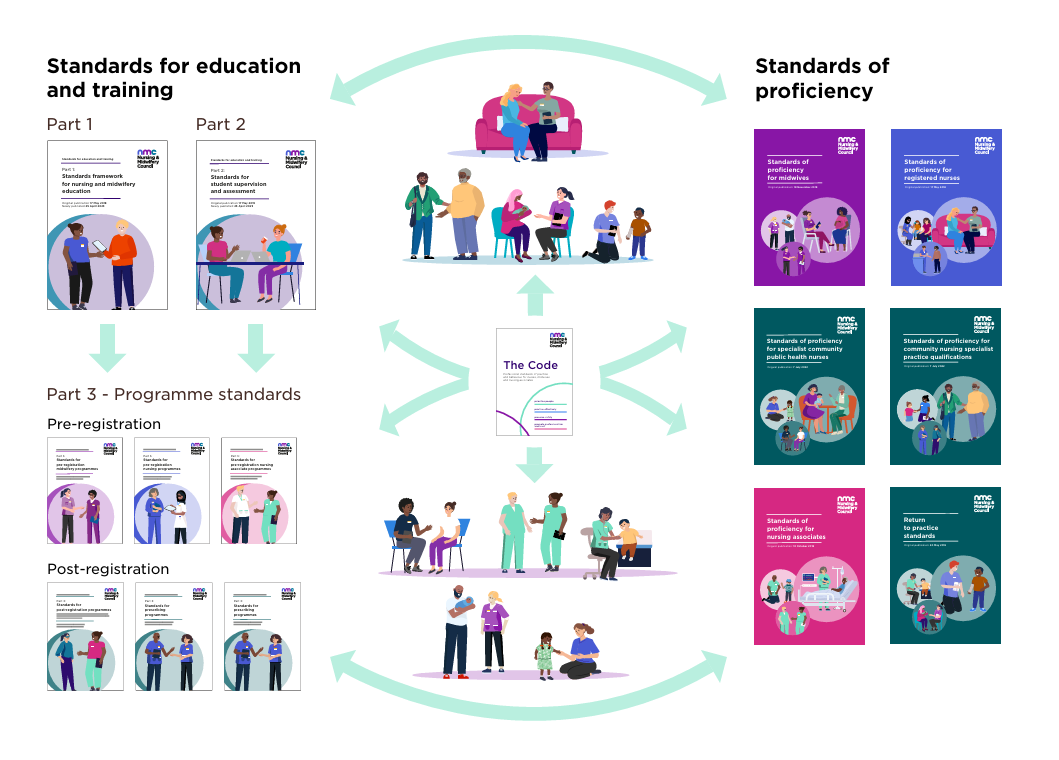
Legistlative framework
Article 15(1) of the Nursing and Midwifery Order 2001 (‘the Order’)2 requires the Council to establish standards for education and training which are necessary to achieve the standards of proficiency for admission to the register, as required by Article 5(2) of the Order. The Standards for pre-registration nursing associate programmes are established under the provision of Article 15(1) of the Order. Article 5(2) of the Order requires the NMC to establish standards of proficiency necessary to be admitted to each part of the register and for safe and effective practice under that part of the register. The standards of proficiency have been established under this provision.
1. The nursing associate role was introduced and regulated in England from 2019. If other countries of the UK decide to use and regulate the role in future it will require a change to our legislation, and the updating of our standards.
2. SI 2002/253.


