



Education and training beyond initial registration
We recognise that in today’s health and care services, the roles of nurses, midwives and nursing associates (in England) are changing and expanding, requiring higher levels of clinical autonomy, knowledge and skill in order to achieve their full potential and to contribute to the delivery of services for the benefit of the people they serve. Everyone on our register undertakes additional education and training after their initial professional registration to develop further knowledge and skills, but not all of this ongoing education is, or needs to be, regulated.
We take a proportionate approach to the regulation of post-registrationqualifications. We reserve regulation for those areas where ensuring consistency of standards of proficiency, and standards for education and training, is needed to achieve a higher level of quality and safety in order to mitigate risk and to reassure the public. One of the means that we have of recognising post-registration qualifications is through setting standards for specialist practice qualifications (SPQs).
Specialist practice qualifications are annotations to our register. They indicate that a registered nurse has successfully undertaken an NMC approved SPQ programme that meets our standards in a particular area of practice. To undertake a specialist practice qualification, you must be a first level registered nurse.
Community nursing in the 21st century
In the 21st century, support and care of people of all ages is increasingly being delivered in the community, in people’s homes and in settings close to their homes. These settings include care homes, hospices, general practice, residential and educational settings, and prisons and offender health settings. As a result, new models of community care are emerging, new nursing roles have been developed and there are likely to be more in the future. The limited number of community nursing SPQs that we currently have – community children’s nursing, community learning disabilities nursing, community mental health nursing, district nursing and general practice nursing – no longer represent the totality of specialist nursing practice
in the community.
Holding a community nursing specialist practice qualification is not a requirement to work in the community or to care for any individual client group. For the majority of nursing roles, a combination of the standards of professional behaviour and conduct enshrined in the Code, and the requirement to meet the knowledge and skills specified in the pre-registration nursing standards of proficiency, along with subsequent and ongoing revalidation, is sufficient for effective regulation. In order to take a proportionate approach, we need to consider which roles and activities justify regulation at a post-registration level.
About these standards
This document contains our new outcome-focused specialist community nursing standards of proficiency for registered nurses. These proficiencies reflect the specialist knowledge, skills and attributes required by nurses working in the community in any roles which involve more autonomous
decision-making, in situations that require registered nurses to manage greater clinical complexity and risk, both in terms of the people they care for, the caseloads they manage and the services they work within, which in turn may be integrated with other agencies, professionals and disciplines.
In our 2020-2025 strategy we have made a commitment to explore whether the regulation of advanced practice is needed. These new specialist community nursing qualifications incorporate standards of proficiency that will support registered nurses working in the community to advance their clinical, managerial, research and educative practice. This will enable greater clinical autonomy, independent decision-making and leadership in complex and high-risk situations for the benefit of people and services.
It is likely that more community nursing roles will be developed in the future that also demand higher levels of clinical autonomy. These standards therefore serve to build on current good practice and intend to promote learning and create ambition and opportunity for other registered nurses who work in the community. This is why we have introduced a new SPQ for other fields of community nursing practice.
The nature of regulatory standards
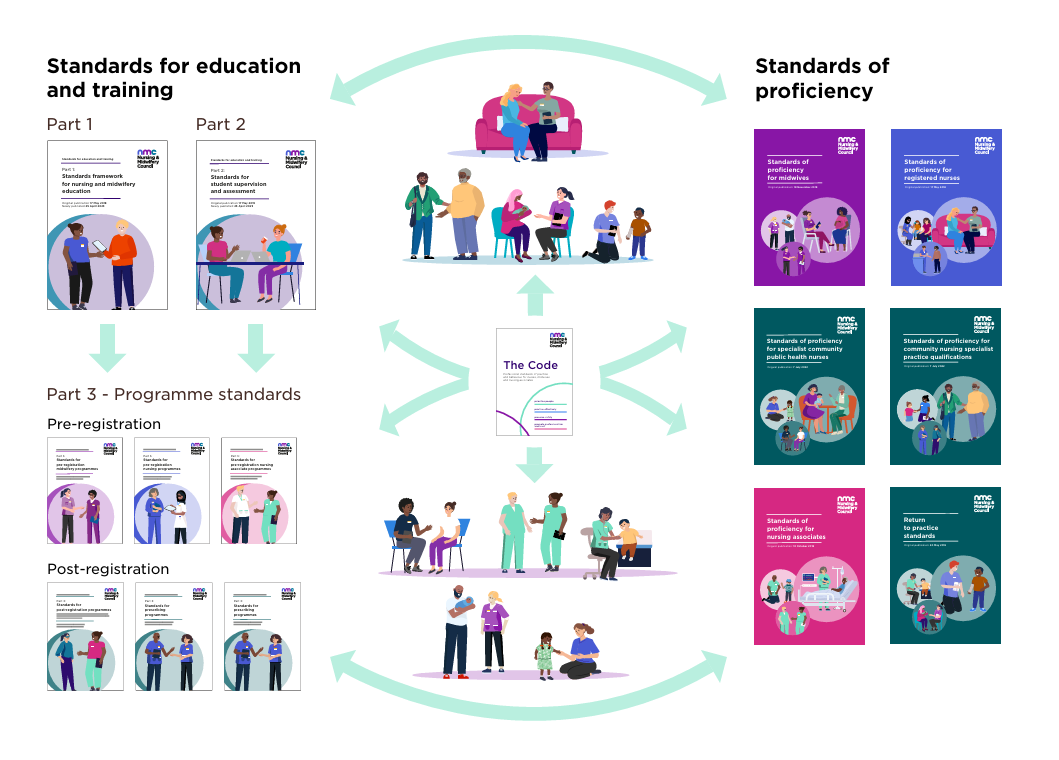
Regulatory standards are intended to be high level and outcome-focused. They are translated by education institutions and their practice placement partners into more detailed curricula and programme learning outcomes. These standards apply to all fields of community nursing practice, however the evidence base and their application in different fields of community nursing will differ. These standards should therefore be read alongside the standards for education and training, which sets out our expectations regarding provision of all pre-registration and post-registration NMC approved nursing and midwifery education programmes.
These standards apply to all approved education providers and are set out in three parts:
• Part one: Standards framework for nursing and midwifery education
• Part two: Standards for student supervision and assessment
• Part three: programme standards, which are the standards specific for each pre-registration or post-registration programme.
Educational institutions must meet our programme standards in order to be approved to deliver a programme which leads to one of the following SPQs: community children’s nursing, community learning disabilities nursing,
community mental health nursing, district nursing, general practice nursing or specialist community nursing.
The rationale for the new community nursing SPQ annotation which does not specify a particular field of community nursing role is that it can be applied to registered nurses who work in different community roles,
including potential new roles that are emerging in the community, which require professionals to have the knowledge and skills that are specified in these standards in order to practise with higher levels of clinical autonomy and provide a better service for the people in their care.
Together these standards aim to provide Approved Education Institutions (AEIs) and their practice learning partners with the flexibility to develop innovative approaches to education, helping registered nurses to achieve
a community nursing SPQ qualification, while also being accountable for the local provision and management of approved post-registration community nursing SPQ programmes in line with our standards. The relationship between the different sets of standards is shown in the diagram on the next page.
Structure of these standards
The approach to the standards of proficiency for community nursing specialist practice qualifications aligns with that of our Standards of proficiency for registered nurses.
The standards are organised under seven headings, and were designed to ensure that across all fields of nursing practice, registered nurses are able to meet the person-centred, holistic care needs of the people they encounter in their practice who may have a range of mental, physical, cognitive, behavioural, social or spiritual needs. This ambition also applies to specialist
community nursing to meet the diverse needs of people of all ages, in their home, in settings close to home and in the community.
Professionals on our register already possess the knowledge and skills required to be registered as a nurse. These specialist community nursing standards of proficiency state the additional knowledge and skills required for community nursing SPQs.
These proficiencies will provide new post-graduate community nurses with SPQs entering the profession with the knowledge, skills and behaviours they need when they record their qualification on the register. Community nurses with a SPQ will build on these proficiencies as they gain experience and fulfil their professional responsibility. They will demonstrate their commitment to
develop as a specialist community practitioner and to build a career pathway, engaging in ongoing education and professional development opportunities necessary for revalidation.
The seven platforms
Platform 1: Being an accountable, autonomous professional and partner in care
Platform 2: Promoting health and wellbeing and preventing ill health
Platform 3: Assessing people’s abilities and needs, and planning care
Platform 4: Providing and evaluating evidence-based care
Platform 5: Leading, supporting and managing teams
Platform 6: Leading improvements in safety and quality of care
Platform 7: Care coordination and system leadership
Taken together these proficiencies, developed in an appropriately structured educational programme, will provide nurses undertaking community nursing SPQs with the knowledge, skills and behaviours they need to work within their intended field of community nursing practice.
Legislative framework
Article 19(6) of the Nursing and Midwifery Order 2001 (‘the Order’) allows the NMC to establish standards of education and training for any additional qualifications that may be recorded on the register. Articles 15(3) to (9) and articles 16 to 18 of the Order will apply in respect of those standards as if they were standards established under article 15(1)(a). This means the NMC may establish standards of education and training and may approve a course of education or qualification in relation to SPQs.


