


In this guide
- Proficiency Outcomes
- Communication, sharing information and relationship management: shared skills for Domains 1, 2, 3, 4 and 5
- Approaches for building relationships and sharing information with women, their partners and families that ensures that women’s needs, views, preferences, and decisions can be supported in all circumstances
Midwives are skilled, autonomous practitioners who apply knowledge safely and effectively, to optimise outcomes for all women and newborn infants. They combine clinical knowledge, understanding, skills, and interpersonal and cultural competence, to provide quality care that is tailored to individual circumstances. They assess, plan, provide, and evaluate care in partnership with women, referring to and collaborating with other health and social care professionals as needed. They continue to enhance their midwifery practice for the benefit of women, newborn infants, partners, and families.
Proficiency Outcomes
Back to top
At the point of registration, the midwife will be able to:
6.0safely demonstrate evidence-based best practice in all core and domain-specific skills and procedures listed below:
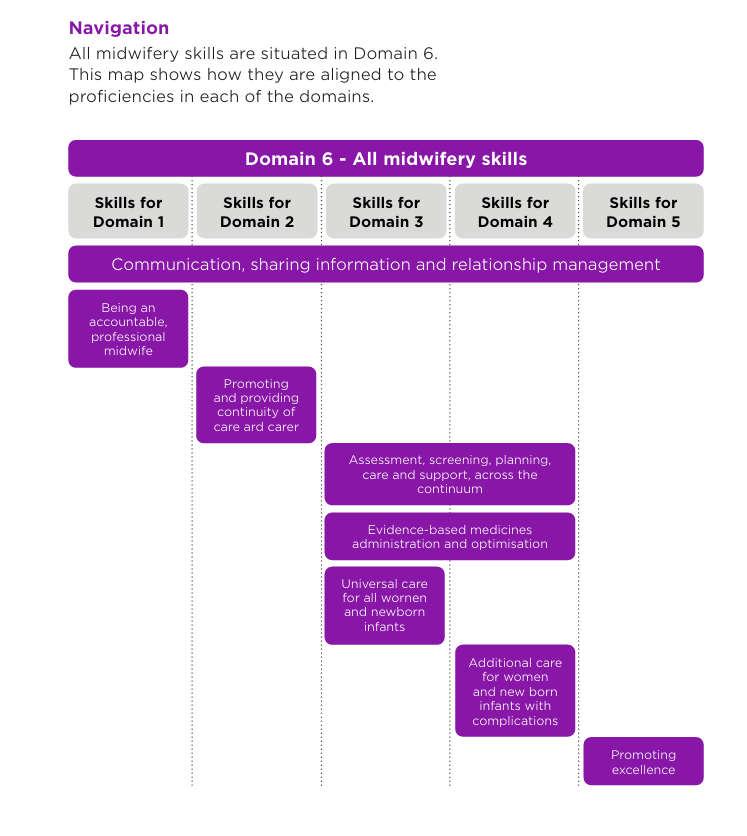
Communication, sharing information and relationship management: shared skills for Domains 1, 2, 3, 4 and 5
Back to top
Skills when communicating with women, their partners and families, and colleagues that take account of women’s needs, views, preferences, and decisions
6.1demonstrate the ability to use evidence-based communication skills when communicating and sharing information with the woman, newborn infants and families that takes account of the woman’s needs, views, preferences, and decisions, and the needs of the newborn infant
6.1.1actively listen, recognise and respond to verbal and non-verbal cues
6.1.2use prompts and positive verbal and non-verbal reinforcement
6.1.3use appropriate non-verbal communication techniques including touch, eye contact, and respecting personal space
6.1.4make appropriate use of respectful, caring, and kind open and closed questioning
6.1.5check understanding and use clarification techniques
6.1.6respond to women’s questions and concerns with kindness and compassion
6.1.7avoid discriminatory behaviour and identify signs of unconscious bias in self and others
6.1.8use clear language and appropriate resources, making adjustments where appropriate to optimise women’s, and their partners’ and families’, understanding of their own and their newborn infant’s health and wellbeing
6.1.9recognise the need for, and facilitate access to, translation and interpretation services
6.1.10recognise and accommodate sensory impairments during all communications
6.1.11support and manage the use of personal communication aids
6.1.12identify the need for alternative communication techniques, and access services to support these
6.1.13communicate effectively with interdisciplinary and multiagency teams and colleagues in all settings to support the woman’s needs, views, preferences, and decisions
6.1.14maintain effective and kind communication techniques with women, partners and families in challenging and emergency situations
6.1.15maintain effective communication techniques with interdisciplinary and multiagency teams and colleagues in challenging and emergency situations.
Approaches for building relationships and sharing information with women, their partners and families that ensures that women’s needs, views, preferences, and decisions can be supported in all circumstances
Back to top
6.2demonstrate the ability to use evidence-based approaches to build relationships with women, newborn infants, partners and families that respect and enable the woman’s needs, views, preferences, and decisions
6.2.1build and maintain trusting, kind, and respectful professional relationships
6.2.2convey respect, compassion and sensitivity when supporting women, their partners and families who are emotionally vulnerable and/or distressed
6.2.3demonstrate the ability to conduct sensitive, individualised conversations that are informed by current evidence on public health promotion strategies
6.2.4demonstrate effective communication to initiate sensitive, compassionate, woman-centred conversations with pregnant women and new mothers around infant feeding and relationship building
6.2.5engage effectively in difficult conversations, including conversations about sensitive issues related to ethical dilemmas and breaking bad news, and sexuality, pregnancy, childbirth and the newborn infant
6.2.6demonstrate the ability to explore with women their attitudes, beliefs and preferences related to childbirth, infant feeding, and parenting, taking into account differing cultural contexts and traditions
6.2.7provide effective and timely communication with women who experience complications and additional care needs, and their partners and families. This includes support, accurate information and updates on changes whilst continuing to listen and respond to their concerns, views, preferences, and decisions
6.2.8communicate complex information regarding a woman’s care needs in a clear, concise manner to interdisciplinary and multiagency colleagues and teams
6.2.9consult with, seek help from, and refer to other health and social care professionals both in routine and emergency situations
6.2.10demonstrate skills of effective challenge, de-escalation and remaining calm, considering and taking account of the views and decisions made by others.


