


The Nursing and Midwifery Council has a duty to review the standards of proficiency that we set for the professions we regulate on a regular basis. This is to ensure that our standards remain contemporary and fit for purpose to protect the public. In reviewing the standards, we have considered the changes that are taking place in society and health care, and the implications these have for registered nurses of the future in terms of their role, knowledge and skill requirements.
 The proficiencies in this document specify the knowledge and skills that registered nurses must demonstrate when caring for people of all ages and across all care settings. They reflect what the public can expect nurses to know and be able to do to deliver safe, kind and effective nursing care.
They also provide a benchmark for nurses from overseas wishing to join the UK register, as well as for those who plan to return to practice after a period of absence.
The role of the nurse in the 21st century
Registered nurses play a vital role in providing, leading and coordinating
care that is compassionate, evidence-based, and person-centred. They are accountable for their own actions and must be able to work autonomously, as an equal partner with a range of other professionals, and in interdisciplinary teams. In order to respond to the impact and demands of professional nursing practice, they must be emotionally intelligent and resilient individuals who are able to manage their own personal health and wellbeing, and know when and how to access support.
Registered nurses make an important contribution to the promotion of health, health protection and the prevention of ill health. They do this by empowering people, communities and populations to exercise choice, take control of their own health decisions and behaviours, and by supporting people to manage their own care where possible.
Registered nurses provide leadership in the delivery of care for people of all ages and from different backgrounds, cultures and beliefs. They provide nursing care for people who have complex mental, physical, cognitive, and behavioural care needs, those living with dementia, the elderly, and for people at the end of their life. They must be able to care for people in their own home, in the community or hospital or in any health care settings where
their needs are supported and managed.
Registered nurses work in the context of continual change, challenging environments, different models of care delivery, shifting demographics, innovation, and rapidly evolving technologies. Increasing integration of health and social care services will require registered nurses to negotiate boundaries and play a proactive role in interdisciplinary teams. The
confidence and ability to think critically, apply knowledge and skills, and provide expert, evidence-based, direct nursing care therefore lies at the centre of all registered nursing practice.
About our standards
Our standards of proficiency apply to all NMC registered nurses and should be read with our standards for education and training. The standards for education and training set out our expectations regarding delivery of all pre-registration and post-registration NMC approved nursing and midwifery education programmes.
Our standards for education and training apply to all Approved Education Institutions (AEIs) and are set out in three parts: Part one: Standards framework for nursing and midwifery education; Part two: Standards for student supervision and assessment; and Part three: programme standards, which are the standards specific for each pre-registration or post-registration programme. AEIs must comply with our standards to be approved to run any
NMC approved programmes.
Together, the standards for education and training aim to provide AEIs and their practice learning partners with the flexibility to develop innovative approaches to education for nurses, midwives and nursing associates, while being accountable for the local delivery and management of approved programmes in line with our standards. The relationship between the different sets of standards is shown in the diagram on the next page.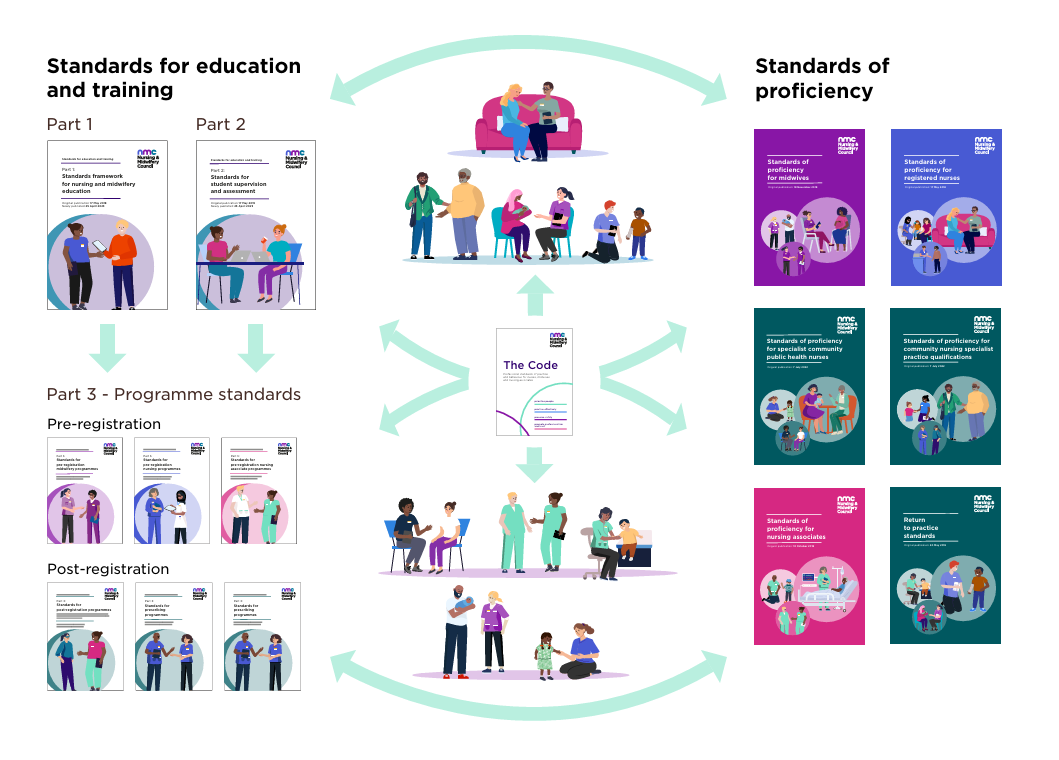
Legislative framework
Article 15(1) of the Nursing and Midwifery Order 2001 (‘the Order’)1 requires the Council to establish standards for education and training which are necessary to achieve the standards of proficiency for admission to the register, as required by Article 5(2) of the Order. The Standards for pre registration nursing programmes are established under the provision of Article 15(1) of the Order.
Article 5(2) of the Order requires the NMC to establish standards of proficiency necessary to be admitted to each part of the register and for safe and effective practice under that part of the register. The standards of
proficiency have been established under this provision.


