




These standards of proficiency apply to all NMC midwives. They should be read with our standards for education and training, which set out our expectations regarding provision of all pre-registration and post-registration NMC approved midwifery education programmes.
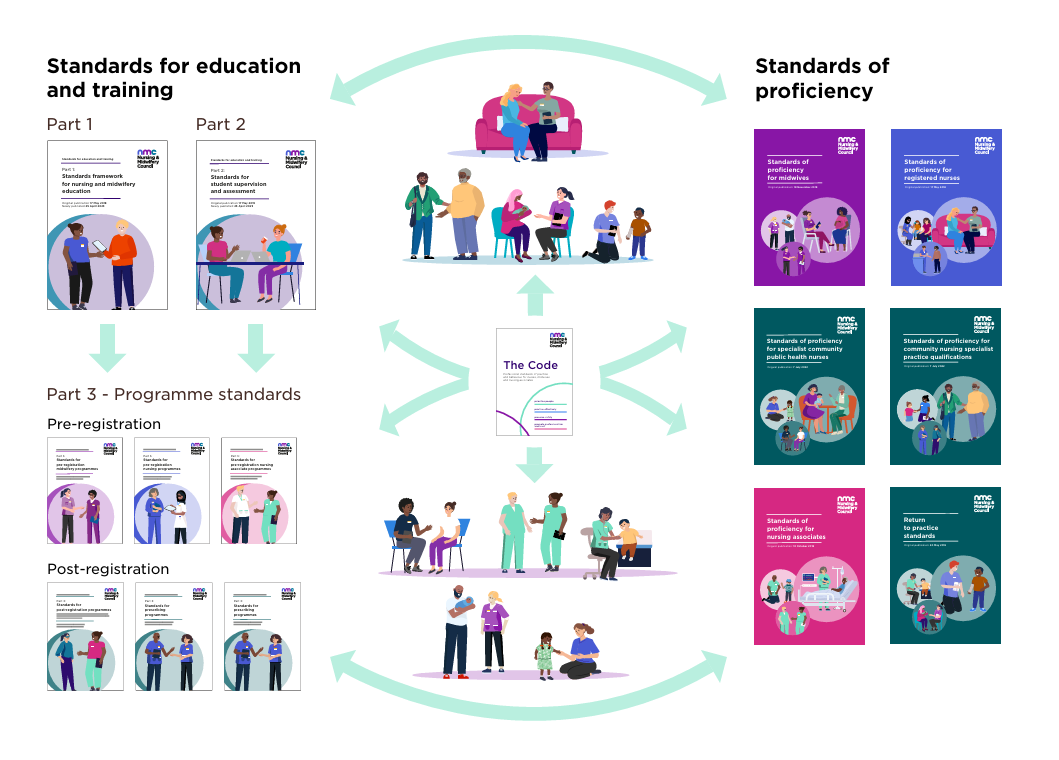
These standards apply to all approved education providers and are set out in three parts; Part one: the standards framework for nursing and midwifery education, Part two: the standards for student supervision and assessment, and Part three: programme standards, which are the standards specific for each pre-registration or post-registration programme.
These standards of proficiency meet the ICM Essential Competencies for Midwifery Practice set by the International Confederation of Midwives. They have been informed by the Unicef UK Baby Friendly Initiative University Standards.
Approved Education Institutions (AEIs) must comply with our standards to be approved to run any NMC approved programmes. Together, the standards for education and training aim to provide AEIs and their practice learning partners with the flexibility to develop innovative approaches to education for midwives, while being accountable for the local provision and management of approved pre-registration midwifery programmes in line with our standards. The relationship between the different sets of standards is shown in the diagram below.
Legislative framework
Article 15(1) of the Nursing and Midwifery Order 2001 (‘the Order’)1 requires the Council to establish standards for education and training which are necessary to achieve the standards of proficiency for admission to the register, as required by Article 5(2) of the Order. The standards for nursing and midwifery education are established under the provision of Article 15(1) of the Order.
Article 5(2) of the Order requires the NMC to establish standards of proficiency necessary to be admitted to each part of the register and for safe and effective practice under that part of the register. The standards of proficiency have been established under this provision.
The evidence
Our standards of proficiency have been developed through an extensive and rigorous process of evidence review and consultation, and consideration of the changing context in which midwives work. They reflect contemporary national and international evidence on the health, wellbeing, needs, views and preferences of women and the needs of the newborn infant.
Our standards of proficiency have drawn on the evidence-informed definition of midwifery and the framework for quality maternal and newborn care from The Lancet Series on Midwifery 2014 in helping to shape the scope and content and ensure a consistent focus on the needs, views, preferences, and decisions of women and the needs of newborn infants across the whole continuum of care.
The definition of midwifery from The Lancet Series on Midwifery
Midwifery is defined as ‘skilled, knowledgeable, and compassionate care for childbearing women, newborn infants, and families across the continuum throughout pre-pregnancy, pregnancy, birth, postpartum, and the early weeks of life. Core characteristics include optimising normal biological, psychological, social, and cultural processes of reproduction and early life; timely prevention and management of complications; consultation with and referral to other services; respect for women’s individual circumstances and views; and working in partnership with women to strengthen women’s own capabilities to care for themselves and their families’2
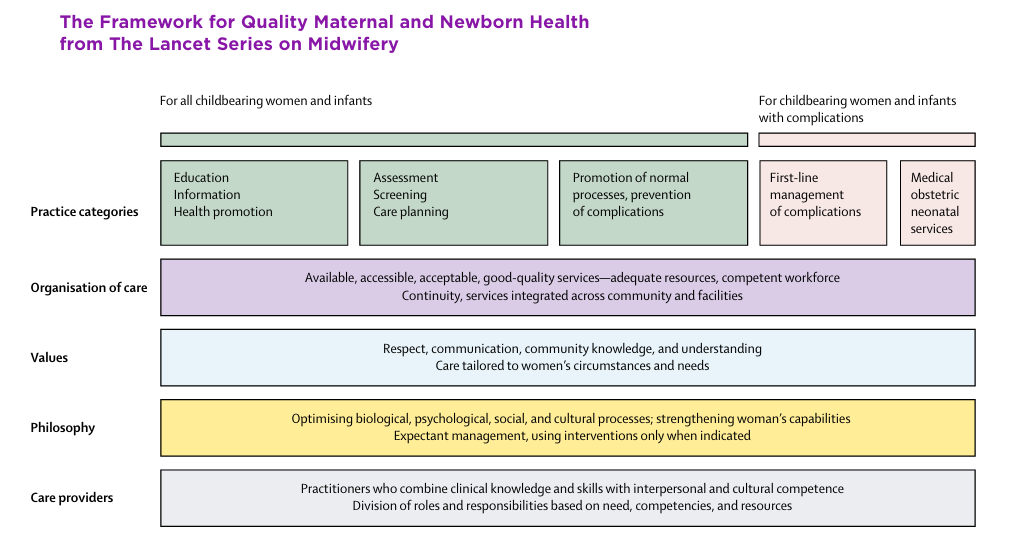
Renfrew, McFadden, Bastos, Campbell et al The Lancet: 384, 1129-1145, 2014 (used with permission)
1SI 2002/253
2Renfrew, McFadden, Bastos, Campbell et al The Lancet 384, 1129-1145, 2014.


