


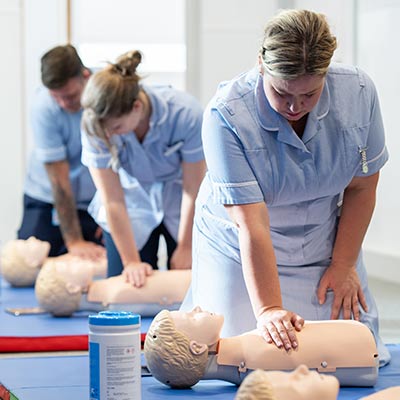



NMC consults on improving nursing and midwifery practice learning
Published on 30 April 2026
The Nursing and Midwifery Council (NMC) has today (30 April) launched a 12-week public consultation on proposed changes to its education standards.
These proposed changes are based on engagement with the NMC’s partners and stakeholders about what they want to see in the updated education and training standards.
It follows research and engagement throughout 2024 and 2025 with students, professionals, approved education institutions (AEIs), practice learning partners (PLP), the public and stakeholders.
This research found that while many students benefit from positive placements, the quality of experiences can vary.
In 2025, alone, the NMC held 25 engagement events, including roundtables and webinars, which were attended by 1,250 people from across the UK, including students and professionals working in practice and higher education.
The proposed changes are influenced by issues emerging in the practice learning landscape, such as the mixed experience of nursing students on practice learning placements and the concerns raised by some student midwives about gaining the confidence and competency they need for practice.
And they include the thought-provoking proposals – based on feedback from the regulator’s stakeholders – to reduce the number of learning hours in nursing programmes, and to extend the length of midwifery programmes.
For nursing programmes, the proposal is to reduce the minimum number of programme hours from 4,600 to 3,600 – to place a greater emphasis on the quality of practice learning experiences rather than the achievement of a set number of practice learning hours.
Globally, there is significant variation in the number of learning hours required to become a registered nurse. The current requirement of 4,600 hours stems back to EU legislation which no longer applies to the UK.
Outside of the EU, there is significant variation in the number of nursing programme hours and within this, the number of practice hours. They are generally lower than the hours mandated by the EU directive – 4,600 in total, of which 2,300 are practice learning.
For example in the USA, students are required to complete around 700 hours of practice learning, 800 hours in Australia and 1,100 hours in New Zealand.
Reducing the minimum requirement for practice learning hours would give approved education institutions (AEIs) the opportunity to design more innovative and creative programmes – with a lower minimum to meet, the emphasis could shift more clearly towards the quality of learning rather than the quantity of hours.
The midwifery proposal is to extend programmes from three to four years – against the backdrop of high-profile inquiries into maternity care across the four nations of the UK, which have investigated concerns about the safety, quality and culture of maternity and neonatal services.
There is also growing evidence that maternity outcomes and experiences vary greatly for women and mothers. Figures released by MBRRACE-UK show that Black women are three times more likely, and Asian women are 1.3 times more likely, to die during pregnancy or postnatally than White women. The figures also show that Black babies are over twice as likely to be stillborn as White babies – with Asian babies 50% more likely to be stillborn.
Since introducing its Standards for pre-registration midwifery programmes in 2019, the NMC has heard feedback about the challenges students can face in meeting all requirements within a three-year programme.
This includes concerns about whether students have sufficient time to gain exposure to a wide range of practice scenarios – including caring for women and mothers from diverse backgrounds.
The regulator’s engagement with stakeholders has highlighted that, for many students, the current length of midwifery programmes results in task-oriented learning – rather than enabling students to have quality practice learning placements which prioritise holistic care for a diverse range of women, newborn infants and their families.
Extending midwifery programmes would therefore allow more time for students to achieve the proficiencies set out in the NMC’s standards.
Other areas for consultation include:
- Strengthening anti-racism, bias awareness and cultural curiosity, safety and respect in nursing and midwifery education and training
- If pre-registration nursing programme hours are reduced, requiring pre-registration nursing associate programmes to be a minimum of 2,300 hours – not 50% of the nursing programme hours as set out in the current standard, and
- Ensuring that all nursing students have at least one community practice learning experience in health or social care.
Based on the feedback, the NMC is proposing profound changes to its standards. The regulator recognises that there will be a wide spectrum of opinion on these proposals – it is launching the formal consultation to ensure these opinions are fully analysed to inform any final proposed changes.
The full set of proposals and accompanying rationales can be found in the consultation document.
Modernising the standards - a roadmap
The review forms part of an essential roadmap – alongside the modernisation of the Code and Revalidation process, and the NMC’s advanced practice review – to support nursing and midwifery practice and protect the public through modernised standards.
Education standards must reflect the significant changes that have impacted the delivery of health and care in recent years, from equity, diversity and inclusion to the Covid-19 pandemic, high profile inquiries and the progression of artificial intelligence.
Have your say
The consultation is open to everyone – whether they are a nursing or midwifery professional, student, educator, AEI, PLP, member of the public, stakeholder, or someone involved in the wider health and social care sector.
Comments can be submitted via an online survey – the NMC recommends reading the consultation document first. The consultation closes on 23 July.
Professor Donna O’Boyle MBE, NMC Acting Executive Director for Professional Practice, said:
“We appreciate that some of our proposals will be thought-provoking across the professions, however they are based on the feedback we received during our period of research.
“Practice learning is a vital part of how students build the confidence, skills, knowledge and behaviours they need to join the Register.
“Throughout this review, we have heard how and why students’ practice learning experiences can vary. Drawing on these insights, we are now consulting on changes to our nursing and midwifery education standards, and we want to hear from as many people as possible.
“We’re seeking views from professionals, students, approved education institutions, practice learning partners, the public, and stakeholders across the UK; this includes people from a wide range of backgrounds and with different protected characteristics.
“Together, these views will help shape the future of practice learning for nursing and midwifery students, supporting them to deliver the high-quality, person-centred care for people from the point they qualify and throughout their careers.”
Next steps
The NMC will continue to engage closely with stakeholders and subject matter experts from across the UK during the consultation – many of whom form part of the review’s independent steering group, and student and public advisory groups.
Thinks Insight & Strategy (Thinks), an independent research company, will analyse all responses. They will also carry out qualitative research, including focus groups and interviews, with stakeholders, students, professionals and members of the public, and all these findings will inform the NMC’s next steps.
Read more about the consultation and share your views
Further information
The NMC is consulting on changes to the following nursing and midwifery education standards:
Standards for pre-registration nursing programmes
Standards for pre-registration nursing associate programmes
Standards for pre-registration midwifery programmes
Standards framework for nursing and midwifery education and training
Standards for student supervision and assessment
- This consultation is open for 12 weeks from Thursday 30 April until Thursday 23 July.
- People can respond to the consultation here or email the NMC with any questions.
- If anyone needs support completing the survey, they can contact consultations@nmc-uk.org.
- If you’d like to be kept up to date on progress, and any opportunities to get involved, please sign up to our community of interest.
- More information about our practice learning review can be found here.
- We run informal drop-in sessions for academics and practice learning partners to ask any questions relating to NMC standards implementation or other education queries. More information and details on how to sign up are available here.
Other recent news…
NMC responds to new Skills for Care report into adult social care
Published on 14 October 2026
Skills for Care have today (14 October) published their annual 'State of the adult social care sector and workforce in England' report.
NMC Chief Executive named among health and care’s most influential Black, Asian and minority ethnic leaders
Published on 13 October 2026
The Health Service Journal (HSJ) has named NMC Chief Executive and Registrar Paul Rees MBE as one of the top 75 most influential Black, Asian and minority ethni
Lesley Maslen to step down as Executive Director of Professional Regulation
Published on 12 October 2026
The Nursing and Midwifery Council (NMC) has announced that Lesley Maslen, Executive Director of Professional Regulation, will step down on 30 November after fou

